




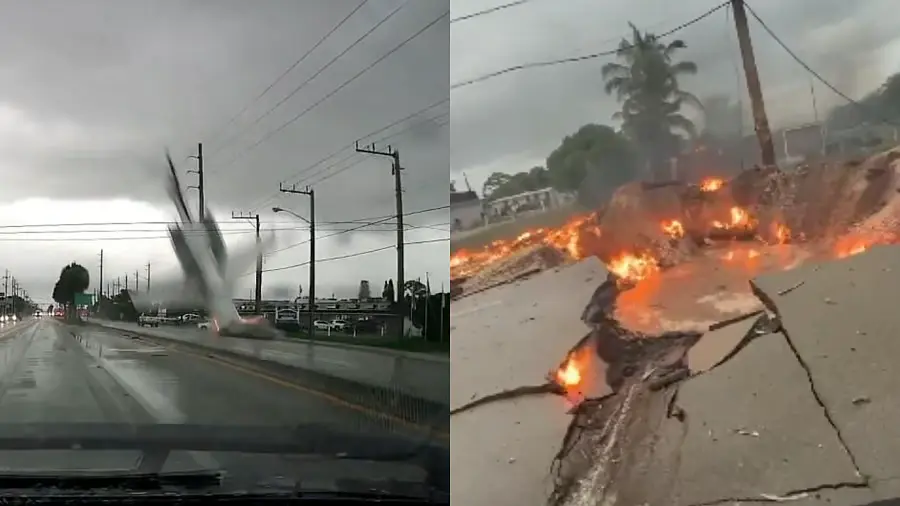
A devastating plane crash in South Florida has killed all nine people aboard a private business jet after it plunged into a residential neighbourhood in Palm Beach County on Sunday, November 1, 2026. The aircraft, identified as a Learjet 60, was travelling from Austin, Texas, to the Bahamas when it crashed near Cresthaven in the Greenacres area.
The aircraft reportedly went into a steep descent before striking the ground near a busy roadway and bursting into flames. The impact created a large crater and sent thick black smoke into the surrounding area, raising serious concerns among residents living close to the crash site.
US Transportation Secretary Sean Duffy confirmed that all nine people aboard the aircraft had died. Florida Governor Ron DeSantis described the incident as a major tragedy, while emergency response teams and federal investigators were deployed to the area.
The National Transportation Safety Board (NTSB) has taken the lead in investigating the accident, with support from the Federal Aviation Administration (FAA). Early reports indicate that the flight crew had communicated concerns about icing, turbulence and rapidly worsening flight conditions shortly before the aircraft went down. However, investigators have not yet established the exact cause of the crash.
What Happened in the Florida Plane Crash?
The accident occurred at approximately 12:50 p.m. Eastern Time on November 1, 2026, in Palm Beach County, Florida.
According to preliminary information released by the FAA, the aircraft was a Learjet 60 that had departed from Austin-Bergstrom International Airport in Texas. Its destination was North Eleuthera International Airport in the Bahamas.
During the flight, the crew reportedly experienced icing and moderate turbulence. Air traffic control recordings captured the pilot communicating difficulties and requesting a change in altitude in search of better flying conditions.
Shortly afterwards, the aircraft began losing altitude at an alarming rate. The pilot declared an emergency and reported an overspeed condition as the jet descended rapidly.
The aircraft eventually struck the ground near Military Trail, close to Cresthaven Boulevard and 10th Avenue North. The crash resulted in a major fire and significant damage around the impact area.
According to officials, all nine occupants died. Governor DeSantis said there were no immediate reports of fatalities or injuries among people on the ground.
Florida Plane Crash: Key Details at a Glance
| Particulars | Details |
|---|---|
| Incident | Florida private jet crash |
| Date | November 1, 2026 |
| Approximate time | 12:50 p.m. EDT |
| Aircraft | Bombardier Learjet 60 |
| Aircraft registration | N722BD |
| Crash location | Near Cresthaven, Palm Beach County, Florida |
| Departure airport | Austin-Bergstrom International Airport, Texas |
| Destination | North Eleuthera International Airport, Bahamas |
| People aboard | 9 |
| Confirmed fatalities | 9 |
| Ground casualties | No immediate reports of casualties |
| Weather concerns | Reported icing, turbulence and precipitation |
| Investigating agency | National Transportation Safety Board |
| Supporting agency | Federal Aviation Administration |
| Cause of crash | Under investigation |
Nine People Killed as Private Jet Crashes Near Residential Area
The most serious consequence of the Florida plane crash was the loss of all nine people travelling aboard the aircraft.
US Transportation Secretary Sean Duffy confirmed the deaths following the accident and expressed condolences to the families and loved ones of the victims.
Authorities had not released the identities of the nine occupants in the initial reports. Information about how many were passengers and how many were crew members was also not immediately available.
The aircraft crashed close to a residential community, creating additional concerns about the safety of people living in the surrounding neighbourhood.
Florida Governor Ron DeSantis visited the area and described the incident as a catastrophic accident. He indicated that the aircraft had come down close to homes and a roadway, leaving a significant impact crater.
Although the aircraft burst into flames after hitting the ground, officials reported no immediate casualties among people on the ground.
Around 600 Residents Evacuated Following the Crash
The accident affected more than just the people aboard the aircraft. Its proximity to a residential neighbourhood forced local authorities to take emergency precautions.
According to reports from Palm Beach County officials, approximately 600 residents were affected by the incident and required temporary shelter while emergency operations and the investigation continued.
Authorities arranged accommodation at two local shelters, with the American Red Cross also standing by to assist affected residents.
The crash site was surrounded by emergency personnel as firefighters, law enforcement officers and other response teams worked to secure the area.
Military Trail was closed in both directions near the crash location. Motorists were advised to avoid the affected stretch and use alternative routes.
The evacuation was considered necessary because of the fire, debris and potential hazards around the impact site.
Pilot Reported Icing and Turbulence Before the Aircraft Crashed
One of the most important developments in the investigation is the communication between the flight crew and air traffic controllers before the crash.
According to recordings of air traffic control communications reported by multiple news organisations, the pilot described icing conditions and moderate turbulence during the flight.
The crew reportedly informed controllers that ice was accumulating on the aircraft but initially described the situation as manageable.
The pilot also reported significant turbulence and requested a higher altitude in an attempt to find smoother conditions.
However, the situation deteriorated rapidly.
As the aircraft began losing altitude, the pilot communicated an emergency and reported that the jet was descending at an increasingly dangerous rate.
The reported communications included the following developments:
- The crew reported manageable icing and moderate turbulence.
- The aircraft encountered precipitation.
- The pilot requested permission to climb to a higher altitude.
- The aircraft suddenly entered a rapid descent.
- The pilot reported an overspeed condition and issued a mayday call.
- The crew warned air traffic controllers that the aircraft was about to crash.
The reported descent rate increased from approximately 10,000 feet per minute to 20,000 feet per minute, with flight-tracking data indicating an even higher rate shortly before impact.
These communications could provide investigators with important information about the aircraft’s final moments.
However, icing and turbulence should not yet be treated as confirmed causes of the accident. Investigators will need to examine the aircraft, its systems, flight data and other available evidence before reaching a conclusion.
Could Bad Weather Have Contributed to the Florida Plane Crash?
Weather conditions are among the major factors investigators are likely to examine.
Reports from the area indicated that South Florida was experiencing rain and thunderstorms around the time of the crash. Meteorological reporting also described heavy rainfall, lightning and changing visibility in parts of Palm Beach County.
More importantly, the flight crew had reportedly communicated concerns about icing, turbulence and precipitation while the aircraft was in flight.
Understanding these conditions is essential because severe weather can create multiple challenges for aircraft.
1. Aircraft icing
Ice accumulation on an aircraft can affect its aerodynamic performance. Depending on where ice forms and how much accumulates, it can increase drag, reduce lift and affect the aircraft’s handling.
2. Severe turbulence
Moderate or severe turbulence can cause sudden changes in altitude and airspeed. It can also make it more difficult for pilots to maintain stable flight conditions.
3. Thunderstorms and precipitation
Thunderstorms can create strong updrafts, downdrafts, wind shear and rapidly changing atmospheric conditions. These factors can pose serious challenges to aircraft.
4. Rapid changes in flight conditions
When icing, turbulence and other adverse weather conditions occur together, pilots may face additional operational challenges.
Nevertheless, the presence of thunderstorms in the region does not establish that weather caused this particular crash. Investigators must determine the actual conditions encountered by the Learjet at altitude and whether they contributed to the aircraft’s loss of control.
What Type of Aircraft Was Involved? Understanding the Learjet 60
The aircraft involved in the accident was a Bombardier Learjet 60, a twin-engine business jet designed for private and corporate aviation.
According to aviation reporting and aircraft registration records, the aircraft involved was registered as N722BD and was manufactured in 2004.
The Learjet 60 is designed for business travel and can operate at high altitudes. Like other business jets, it is equipped with systems intended to support safe flight operations in different weather conditions.
However, no aircraft is immune to extreme weather, technical failures or other unexpected emergencies.
Investigators will need to examine the aircraft’s maintenance history, technical condition, flight systems and operational records to determine whether any mechanical or structural problem contributed to the accident. Aviation International News+1
NTSB Investigation: What Happens Next?
The National Transportation Safety Board (NTSB) is leading the investigation into the Florida plane crash, while the FAA is providing assistance.
The investigation will focus on identifying what caused the aircraft to enter such a rapid descent and why the crew could not recover control before impact.
Several important areas are expected to receive attention.
| Investigation area | What investigators will examine |
|---|---|
| Aircraft wreckage | Physical damage, structural failures and impact evidence |
| Flight data | Altitude, airspeed, descent rate and aircraft performance |
| Cockpit communications | Pilot conversations and emergency communications with air traffic control |
| Weather conditions | Icing, turbulence, precipitation and thunderstorms |
| Engine and aircraft systems | Possible mechanical, electrical or engine-related failures |
| Maintenance records | Previous repairs, inspections and maintenance history |
| Flight operations | Crew decisions, procedures and response to the emergency |
Investigators may also examine available flight-tracking information, surveillance footage, dashcam recordings and witness accounts.
The aircraft’s flight recorders, if recovered and usable, could provide critical information about the final stages of the flight.
The NTSB’s preliminary findings may help establish the sequence of events, but determining the full cause of an aviation accident can take considerably longer.
It is important to distinguish early investigative findings from a final accident report. No definitive conclusion about the cause should be drawn until investigators have completed their technical analysis.
Why Is This Florida Plane Crash Raising Aviation Safety Concerns?
The accident has raised several concerns because of the aircraft’s sudden descent, the reported weather difficulties and the fact that it crashed close to a residential community.
There are three major issues that make the incident particularly significant.
1. Sudden loss of altitude
The aircraft reportedly went from cruising at high altitude to an extremely rapid descent within a short period. Understanding what triggered this change will be a central part of the investigation.
2. The role of weather in private aviation
The reported icing and turbulence have renewed attention on how aircraft and flight crews respond to changing weather conditions, particularly during high-altitude operations.
3. Risks to people on the ground
The aircraft came down close to homes, vehicles and a mobile home community. Although officials reported no immediate ground casualties, the accident demonstrates the potential danger of aircraft emergencies occurring over populated areas.
The investigation could provide important lessons for aviation safety, aircraft operations and emergency response procedures.
Timeline of the Florida Learjet Crash
The following timeline is based on currently available flight-tracking information, air traffic control communications and official statements.
| Time (EDT) | Reported development |
|---|---|
| 11:37 a.m. | Aircraft departs Austin-Bergstrom International Airport (reported departure in UTC converted to local time) |
| Around 12:35 p.m. | Flight-tracking data shows the aircraft operating at approximately 35,000 feet |
| Before 12:50 p.m. | Crew reports icing, turbulence and precipitation |
| Shortly before 12:50 p.m. | Pilot requests a higher altitude |
| Around 12:49–12:50 p.m. | Aircraft enters a steep descent and crew declares an emergency |
| Around 12:50 p.m. | Learjet crashes in Palm Beach County |
| After the crash | Emergency services respond and the surrounding area is secured |
| November 1, 2026 | Transportation Secretary confirms all nine people aboard died |
| November 1–2, 2026 | NTSB investigation begins, with FAA assistance |
Note: Times are approximate. The timeline combines flight-tracking data and reported communications; it is not an official NTSB reconstruction. Flightradar24 Blog+2
Current Situation: What Is Confirmed and What Remains Unknown?
As of November 2, 2026, the following information has been established through official statements and published reporting.
| Issue | Current status |
|---|---|
| Number of people killed | All nine people aboard |
| Victim identities | Not publicly confirmed in initial reports |
| Aircraft identification | Learjet 60, registration N722BD |
| Flight route | Texas to the Bahamas |
| Weather conditions | Icing, turbulence and precipitation reported by the crew |
| Ground casualties | No immediate reports of fatalities or injuries |
| Residential evacuation | Approximately 600 residents affected |
| Mechanical failure | Not established |
| Weather as the cause | Not established |
| Final crash investigation report | Not available |
| Investigation authority | NTSB, supported by FAA |
These distinctions are important because early aviation accident reports often contain incomplete information. The final explanation will depend on evidence collected and analysed by investigators. CBS Miami+2
Conclusion
The Florida Learjet 60 crash is a major aviation tragedy that has claimed nine lives and disrupted an entire residential community in Palm Beach County.
While early reports highlight icing, turbulence, precipitation and a sudden loss of altitude, the exact circumstances behind the accident remain unknown.
The NTSB investigation will be crucial in determining whether the crash involved adverse weather, technical problems, aircraft performance issues, operational factors or a combination of circumstances.
For now, the priority remains supporting the affected families and residents while investigators work to establish what happened during the aircraft’s final moments.
Further conclusions about the cause of the crash should be based on verified findings from the NTSB rather than early speculation.