



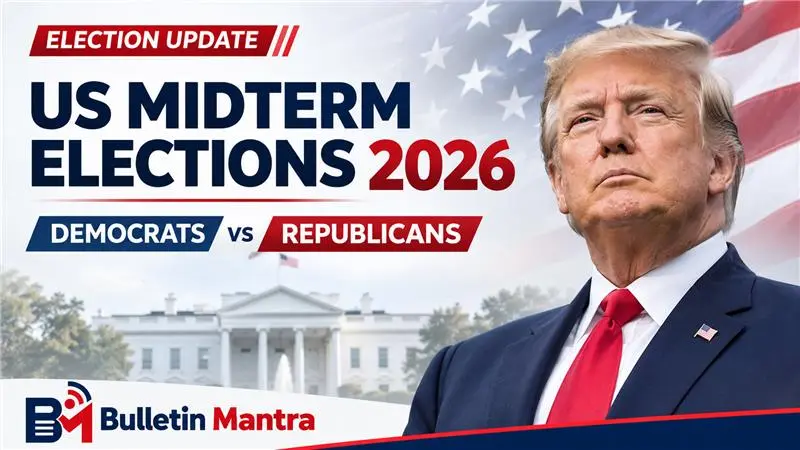
Washington, November 4, 2026: The 2026 United States midterm elections have delivered a significant political setback for President Donald Trump and the Republican Party. Democrats have won control of both chambers of Congress, the US House of Representatives and the Senate, according to the Associated Press.
The election, held on November 3, 2026, was closely watched across the country because it offered American voters an opportunity to influence the balance of political power during Trump’s presidency.
Democratic candidates secured important victories in several traditionally Republican states, including Texas, Iowa, Kansas, Ohio, North Carolina and South Carolina. These results represent a major shift in the political landscape and could significantly influence the remaining two years of Trump’s presidency.
The results also raise important questions about the Republican Party’s political strategy, the Democratic Party’s growing momentum and the future direction of American politics.
For people searching for 2026 US election results, US midterm election results, Donald Trump’s political party and Democrats vs Republicans, here is a detailed explanation of the election, its outcome and what it means for the United States.
2026 US Midterm Election Results: Latest Overview

The November 3 election has changed the balance of power in Washington. Democrats have secured control of Congress, ending the Republican Party’s control of both chambers.
Here is a quick overview of the major developments.
| Election detail | Latest information |
|---|---|
| Election | 2026 US Midterm Elections |
| Election date | November 3, 2026 |
| Latest update | November 4, 2026 |
| Current US President | Donald Trump |
| Trump’s political party | Republican Party |
| Democratic Party | Won control of Congress |
| Republican Party | Lost control of Congress |
| House of Representatives | Democrats win control |
| US Senate | Democrats win control |
| Next presidential election | 2028 |
Important: These are reported election outcomes and party-control developments, not a statement that every individual race has completed its official state certification. Some local and congressional counts may continue.
Who Won the 2026 US Midterm Elections?
The Democratic Party has won the 2026 US midterm elections by securing control of both the House of Representatives and the Senate, according to AP’s election coverage.
The outcome is particularly significant because Republicans entered the election controlling both chambers of Congress.
Democrats achieved important victories in states where Republican candidates had previously enjoyed strong electoral support. Their success in states such as Texas, Iowa and Kansas demonstrates the scale of the political shift.
The election also brought notable victories in gubernatorial contests, with Democratic candidates winning important Republican-held state governorships.
The results are being viewed as a major rejection of Republican governance under President Donald Trump, although the political reasons behind individual voting decisions vary across states and voter groups.
Why Are the 2026 US Midterm Elections Important?
The US midterm elections are among the most important political events between two presidential elections.
Unlike presidential elections, where voters choose the country’s president, midterm elections primarily determine the composition of Congress.
Congress plays an important role in making federal laws, approving budgets, overseeing government activities and checking presidential authority.
The 2026 election is particularly important because it has changed the political balance between the White House and Congress.
With Democrats controlling both chambers, President Trump will face a Congress led by the opposition party during the remaining years of his current presidential term.
What Are Midterm Elections in the USA?
Midterm elections are elections held halfway through a US president’s four-year term. They allow American voters to elect members of Congress and influence which political party controls the legislative branch.
The elections take place every two years, but the elections held halfway between presidential elections are specifically called midterm elections.
The 2026 midterms took place during Donald Trump’s second presidential term, which began in January 2025.
Which positions are elected during US midterm elections?
There are two major parts of Congress:
1. US House of Representatives
- The House has 435 voting members.
- All 435 seats are contested during midterm elections.
- Representatives serve two-year terms.
- The party that secures at least 218 seats can hold a majority.
2. US Senate
- The Senate has 100 members.
- Senators serve six-year terms.
- Approximately one-third of Senate seats are contested every two years.
- A party generally needs 51 seats for a majority, although a 50-50 Senate can be controlled through the vice president’s tie-breaking vote.
| Feature | House of Representatives | US Senate |
|---|---|---|
| Total members | 435 | 100 |
| Term duration | 2 years | 6 years |
| Seats contested in 2026 | All 435 | 35 |
| Majority requirement | 218 | Generally 51 |
| Main responsibility | Federal legislation and representation | Federal legislation, confirmations and treaties |
The outcome of these elections determines which party has greater influence over legislation and congressional oversight for the next two years.
Donald Trump: Which Political Party Does He Belong To?
Donald Trump
Republican Party
- 47th President of the United States
- Took office on January 20, 2025
- Political affiliation: Republican
One of the most frequently searched questions during the American elections is: Is Trump a Democrat or Republican?
Donald Trump belongs to the Republican Party, not the Democratic Party.
He was the Republican presidential nominee in the 2016, 2020 and 2024 elections. He won the 2016 and 2024 presidential elections and lost the 2020 election to Joe Biden.
Trump is associated with the conservative wing of American politics and the Make America Great Again (MAGA) movement.
As president, he leads the executive branch, while the Republican Party is his political party. These are separate roles: the president does not personally control every decision made by Congress.
His party’s performance in the 2026 midterms is therefore politically significant because the Republican Party has lost its previous congressional majorities.
What Role Did Donald Trump Play in the 2026 Elections?
Donald Trump was not a presidential candidate in the 2026 midterm elections. However, his presidency and political influence were central to the election campaign.
The midterms became an important assessment of his administration’s performance.
Trump encouraged voters to support Republican candidates and attempted to make the election a reflection of his political agenda. Several Republican candidates also relied on his political support and association with the MAGA movement.
However, the results indicate that the Republican Party struggled to retain support in several important states.
1. Trump’s administration became a major election issue
The election campaign was influenced by concerns about the economy, living costs, the Iran war and government corruption.
According to AP’s reporting on its voter poll, many voters appeared to hold the Trump administration responsible for economic pressures and wanted Congress to provide stronger checks on presidential power.
2. Republican candidates faced strong opposition
Democratic candidates won several races in states that had previously supported Trump.
These victories included important Senate contests in Texas, Iowa, Kansas, Ohio, North Carolina and South Carolina.
The results suggest that Republican candidates faced challenges beyond their individual campaigns, including broader dissatisfaction with the administration.
3. Trump responded to the election results
Following the Democratic victories, Trump congratulated Democrats and acknowledged their campaign efforts.
However, he rejected the interpretation that the election was a personal rejection of his presidency. He also suggested that Republican candidates themselves were responsible for their losses.
The election outcome is nevertheless likely to influence his political strategy for the remainder of his term.
Democrats vs Republicans: Understanding America’s Two Major Political Parties
The United States has two dominant political parties: the Democratic Party and the Republican Party.
Both parties compete in presidential, congressional, state and local elections. They have different political philosophies, policy priorities and approaches to governing.
Democratic Party
Common colour: Blue
Generally associated with centre-left and liberal politics.
Republican Party
Common colour: Red
Generally associated with conservative politics.
Key differences between Democrats and Republicans
| Political issue | Democratic Party | Republican Party |
|---|---|---|
| General ideology | Centre-left to liberal | Conservative |
| Economic policy | Generally supports a larger government role in social programmes | Generally favours lower taxes and less regulation |
| Healthcare | Supports a stronger government role in healthcare access | Generally favours market-based approaches and alternatives to federal expansion |
| Immigration | Often supports pathways to legal status and immigration reforms | Generally prioritises border security and stricter immigration enforcement |
| Climate policy | Generally supports stronger climate action | Often prioritises energy production and reducing regulatory restrictions |
| Social issues | Generally supports abortion rights and LGBTQ+ protections | Generally more socially conservative |
| Political symbol | Donkey | Elephant |
These are broad descriptions of the parties’ positions. Individual candidates can have different views, and both parties contain multiple political factions.
Why do Democrats and Republicans compete for Congress?
Congress has significant authority over the country’s laws, budget and government oversight.
When the president’s party controls both chambers, passing legislation can become easier, depending on the issue and the number of votes available.
When the opposition party controls Congress, it can create additional obstacles for the president’s legislative priorities.
That is why the 2026 election result is particularly important for Donald Trump and the Republican Party.
What Does the Democratic Victory Mean for Donald Trump’s Presidency?
The Democratic victory in both chambers of Congress could significantly change the political environment during Trump’s remaining presidential term.
Here are the major implications.
1. Greater congressional opposition
Democrats will have greater authority to shape the legislative agenda, conduct investigations and scrutinise the administration.
2. Challenges to Trump’s legislative agenda
Republican-backed proposals may face stronger opposition in Congress. Negotiations and bipartisan support could become more important for passing legislation.
3. Increased government oversight
Congressional committees can investigate federal agencies, government decisions and administration policies.
4. Budget and spending negotiations
Federal spending legislation and budget negotiations could become more complicated as the two parties attempt to reach agreements.
5. Stronger Democratic political momentum
The election results provide Democrats with an opportunity to build political momentum ahead of the 2028 presidential election.
However, a Democratic congressional majority does not automatically remove Trump from office or transfer presidential powers to the opposition party. Trump remains president until his term ends or another constitutional process changes his position.
Which States Delivered Major Victories for Democrats in 2026?
One of the most significant features of the 2026 US midterm elections was the Democratic Party’s performance in traditionally Republican states.
According to Associated Press election coverage, Democrats secured important Senate victories across several states.
| State | Major election development |
|---|---|
| Texas | Democrat James Talarico won the Senate race |
| Iowa | Democrat Josh Turek won the Senate race |
| Kansas | Democrat Adam Hamilton won the Senate race |
| Ohio | Democrat Sherrod Brown won the Senate race |
| North Carolina | Democrat Roy Cooper won the Senate race |
| South Carolina | Democrat secured a major Senate victory |
| Maine | Democrat Troy Jackson won the Senate race |
These victories were particularly significant because several of the states had supported Trump in the 2024 presidential election.
Democrats also secured important gubernatorial victories, including in Georgia, Ohio, Iowa and Texas.
The results demonstrate that the 2026 election was not limited to congressional competition. It also reshaped political leadership across several states.
What Happens Next After the 2026 US Election Results?
Although Democrats have secured control of Congress, the political transition will take place according to the constitutional timetable.
The newly elected members of Congress are expected to take office on January 3, 2027.
Until then, the existing Congress continues to operate.
The next two years could bring several important developments:
- Democrats will work to establish their legislative priorities.
- Republicans will attempt to maintain influence over federal policy.
- Congressional committees may increase scrutiny of Trump’s administration.
- Both parties will begin preparing for the 2028 presidential election.
- Economic policy, immigration, healthcare and foreign affairs are likely to remain major political issues.
The 2026 midterms have therefore become an important turning point in American politics, with the balance of power shifting away from Trump’s Republican Party.
When Were the 2026 US Midterm Elections Held?
The 2026 US midterm elections took place on Tuesday, November 3, 2026.
American voters participated in congressional, gubernatorial and other state and local elections.
Election results began emerging after polling stations closed across different time zones. Because the United States has different voting schedules and election administration systems across its states, results were reported at different times.
The counting and certification processes are separate from the initial media projections of winners.
2026 US Election Results: What Should Voters and Readers Watch?
The election has settled the immediate question of which party will control Congress, but several developments will remain important.
Congressional seat counts: Remaining uncalled races and final state certifications will determine the precise composition of the new Congress.
Trump’s response: His administration’s approach towards a Democratic-controlled Congress will influence the country’s political direction.
Democratic leadership: The party will need to decide how to use its congressional majority and manage its legislative priorities.
2028 presidential election: Both parties are likely to use the 2026 results to assess voter sentiment, campaign strategies and potential presidential candidates.
For international observers, particularly those following US politics from India, these developments are also important because American political decisions can influence international trade, foreign relations, technology policy and global markets.
FAQs
1. Who won the 2026 US midterm elections?
The Democratic Party won control of both the US House of Representatives and the Senate in the November 3, 2026 midterm elections, according to the Associated Press.
2. Is Donald Trump a Democrat or Republican?
Donald Trump belongs to the Republican Party. He is the 47th president of the United States and returned to office on January 20, 2025.
3. Which party does Trump belong to?
Trump belongs to the Republican Party, also known as the GOP (Grand Old Party).
4. What is the difference between Democrats and Republicans?
The Democratic Party generally follows centre-left and liberal political positions, while the Republican Party generally follows conservative political positions. Both parties have different approaches to economic policy, healthcare, immigration, taxation and social issues.
5. When were the 2026 US midterm elections held?
The 2026 US midterm elections were held on November 3, 2026, a Tuesday.
6. Why are the US midterm elections important?
Midterm elections determine the composition of Congress. They influence which political party controls the House and Senate and how easily the president can implement legislative priorities.
7. Who controls the US Senate after the 2026 elections?
The Democratic Party has won control of the US Senate, according to the Associated Press election coverage.
8. Who won the US House of Representatives elections in 2026?
Democrats won control of the US House of Representatives, ending the Republican Party’s majority.
9. Can Donald Trump be removed from office because Republicans lost the midterm elections?
No. Losing congressional elections does not automatically remove a president. Trump remains president for his constitutional term unless a separate constitutional process changes his position.
10. When will the next US presidential election take place?
The next regularly scheduled US presidential election is in November 2028.
11. What does a Democratic majority mean for Trump?
It means Trump will face opposition-party control in both chambers of Congress. His legislative proposals, budget priorities and administration policies could face increased scrutiny and opposition.
12. Are the 2026 US election results final?
Major party-control outcomes have been reported by the Associated Press. However, individual races can remain uncalled, and official results are subject to state counting and certification procedures.
Conclusion
The 2026 US midterm election results mark a major political development for the United States. Democrats have taken control of both chambers of Congress, delivering a significant setback to Donald Trump and the Republican Party.
The result demonstrates the importance of midterm elections in shaping the country’s political balance, even when the president is not directly contesting an election.
For Trump, the next two years will involve governing alongside an opposition-controlled Congress. For Democrats, the victory brings greater legislative responsibility and an opportunity to influence the country’s political direction.
As the United States moves towards the 2028 presidential election, the consequences of the 2026 midterms will remain an important part of the national political debate.